Design of an ultra-low-power energy-harvesting audio sensor for ecosystem monitoring
Master in Electromechanical Engineering · UCLouvain · Supervisor: Prof. David Bol · June 2020
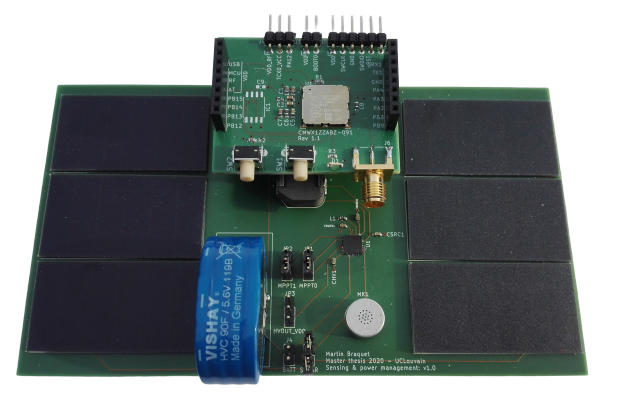
A fully autonomous audio smart sensor designed to continuously monitor forest ecosystems through bird inventory. The device harvests solar energy into a supercapacitor, processes bird calls with an analog front-end and ultra-low-power microcontroller, and transmits species detections wirelessly via LoRaWAN — with a 15+ year lifetime and no battery replacement.
22.1 mWAverage power budgetHarvesting = Consumption
2.5 VOptimised supply voltageBalances all subsystems
15+Years lifetimeSupercapacitor-based storage
94%KNN classifier precision4 Belgian bird species
Context
Autonomous forest monitoring through sound
The Internet of Things promises trillions of connected sensors, but today's battery-powered devices are neither sustainable nor maintenance-free. Meanwhile, forest monitoring — critical in the face of climate change — still relies on infrequent manual sampling. This thesis tackles both challenges at once: a fully energy-autonomous sensor that never needs a battery swap and continuously inventories bird activity as a proxy for ecosystem health.
🌿
Ecosystem degradation
Rising climate change and deforestation demand continuous, dense sensing of forest health. Manual surveys sample data less than once a day — insufficient for meaningful ecological analysis.
♻️
Sustainable IoT
Replacing billions of batteries every two years is not environmentally viable. This sensor uses a supercapacitor with no toxic materials and harvests its own energy from ambient light.
🐦
Bird inventory as a proxy
Bird species richness and activity are well-established indicators of ecosystem health. Automating their detection with embedded ML enables real-time, continuous monitoring at scale.
Architecture
Five-module sensor design
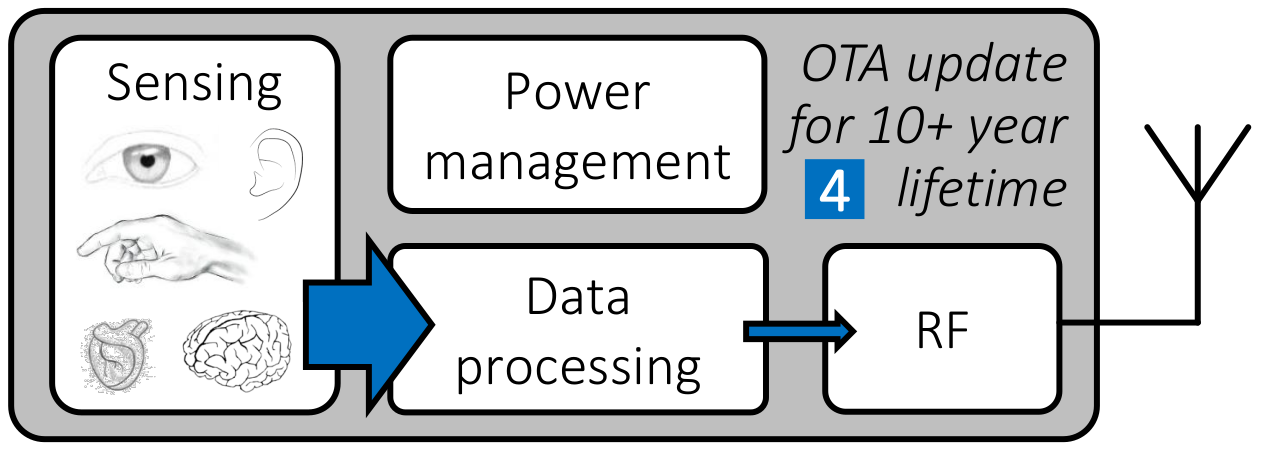
The sensor is decomposed into five interdependent subsystems. The overall supply voltage (2.5 V) was chosen through a multivariate optimisation that simultaneously satisfies the constraints of each module.
01
⚡Energy storage
▸Electrostatic double-layer supercapacitor chosen for its 15+ year lifetime and absence of toxic materials (no lead, no lithium).
▸Sized against seasonal sun-illuminance data to guarantee continuous operation through the worst winter days.
▸Voltage carefully monitored in real time to gate LoRaWAN transmissions only when sufficient energy is available.
02
🔋Power management
▸e-peas AEM10941 PMU (Belgian low-power specialists) mediates power flow between solar cells, supercapacitor, and load.
▸Configurable LDO regulators and Maximum Power Point Tracking maximise solar cell efficiency across illuminance levels.
▸System supply voltage of 2.5 V selected as the multivariate optimum across all subsystems.
03
🎙️Sensing & analog front-end
▸Electret condenser microphone selected after a thorough state-of-the-art comparison: small footprint, 16 dBSPL sensitivity, low noise (14.22 dBSPL input-referred).
▸Custom AFE amplifies the full bird-emission range (20 Hz – 20 kHz) with a power vs. noise trade-off driving op-amp selection.
▸LTspice AC and noise simulations validated against bench measurements.
04
💻Data processing
▸STM32 ultra-low-power microcontroller alternates run/sleep at a one-third duty cycle, minimising average current draw.
▸Weighted-average frequency of received audio fed into a k-nearest neighbours (KNN) classifier running on the bare-metal embedded system.
▸Sensor non-ideality models integrated into the inference pipeline to recover accuracy lost when deploying offline-trained models on real hardware.
05
📡Wireless communication
▸LoRaWAN LPWAN protocol chosen for its kilometre-range, ultra-low-power radio transmissions.
▸Sensor transmits daily bird-species counts and detection frequencies to an edge-computing gateway at night.
▸Over-the-air firmware updates supported: full update costs only 10.6 J, received in fragments when energy is sufficient.
Machine Learning
Embedded bird species classification
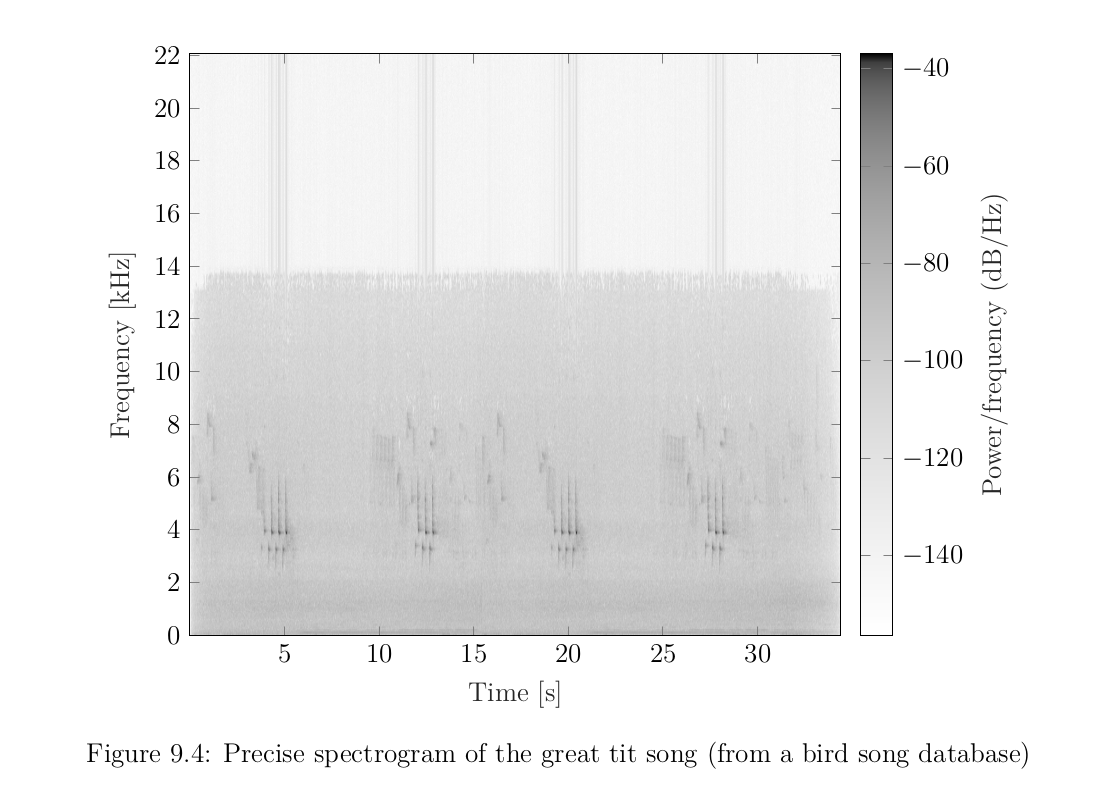
A k-nearest neighbours classifier runs in real time on the STM32 microcontroller, discriminating between four common Belgian bird species using the weighted average frequency of detected songs as the feature vector.
🐦PigeonColumba livia
🐦BlackbirdTurdus merula
🐦Great titParus major
🐦Blue titCyanistes caeruleus
Algorithm pipeline
1Microphone captures audio during daylight hours (12+ h active)
2AFE filters and amplifies signal across 20 Hz – 20 kHz
3STM32 ADC digitises; weighted-average frequency computed per song segment
4KNN classifier matches feature vector against learned species database
5Species count and appearance frequency logged; sent via LoRaWAN at night
Performance
Classifier
k-Nearest Neighbours (KNN)Runs real-time on STM32
Precision (known database)
94%Likelihood of correct species match
Precision (new recordings)
~94%Generalises well to unseen songs
Species supported
4Extensible with more training data
Active sensing window
> 12 h / dayBird-active hours (daytime)
Communication window
NightConditional on supercap voltage
Great Tit Song Spectrogram
Electrical Design
Key specifications at a glance
Power & energy
Supply voltage
2.5 VMultivariate optimum
Average power
22.1 mWHarvesting = Consumption
MCU duty cycle
1/3Run / sleep alternation
OTA firmware update
10.6 JFull update energy cost
Energy source
Photovoltaic cellsMiniaturised, sized for seasons
Storage
Supercapacitor (EDLC)15+ yr · no toxic materials
Sensing & communication
Microphone type
Electret condenserSmall, low-noise, low-power
Sensitivity
16 dBSPLMinimum detectable sound
Input-referred noise
14.22 dBSPLAFE + microphone combined
Audio bandwidth
20 Hz – 20 kHzFull bird-emission range
Wireless protocol
LoRaWAN (LPWAN)LoRa transceiver for IoT
System lifetime
15+ yearsNo maintenance required
Repository
Source files & simulations
The GitHub repository contains all simulation and design files produced during the thesis, organised by subsystem.
Audio processing
C firmware for the STM32 microcontroller; MATLAB scripts to process and plot data received from the board.
Microphone & AFE
LTspice schematics and MATLAB post-processing for AC and noise simulations of the analog front-end.
PCB design
KiCad and Eagle files covering the full schematic and PCB layout for all boards.
Power management
MATLAB and Excel files for supercapacitor, solar cell, PMU, and luminosity measurements.
IV microphone curves
MATLAB code comparing current–voltage characteristics of candidate microphones.
Thesis source (LaTeX)
Complete LaTeX source code of the Master's thesis document, including all figures and bibliography.